Facts vs. Theory vs. Hypothesis vs. Law

PERRA ANAK LANTING (BA18110587)

Facts:

  • Observations about the world around us
  • We develop explanations from that observations

Hypothesis:

  • a proposed explanation for a phenomenon made as a starting point for further investigation
  • Example: why is it bright outside?

1. It’s Armageddon

2. The moon went nova

3. The Sun is out

4. UFO headlights

  • We eliminate things that are wrong
  • Example: we choose The Sun is out
  • NOT an ultimate truth; it’s a POSSIBLE explanation for something
  • One that can lead us to new hypothesis. Whether we’ll agree or disagree. Hypothesis is a NEVER ending stories.

Theories:

  • compilations of hypothesis form a theory
  • A well-substantiated explanation acquired through the scientific method and repeatedly tested and confirmed through observation and experimentation
  • Can be use to make PREDICTIONS
  • It is NOT how things really work, but how things MAY work

Example : FACT – People get sick

: HYPOTHESIS – because something get in their body and starts doing bad things

: THEORY – The Gems Theory of disease

Law:

  • A statement based on repeated experimental observations that describes some phenomenon of nature

COMMUNICATION STUDIES THEORIES (based on University of Twente)

PERRA ANAK LANTING (BA18110487)

These theories are overview according to cluster

Interpersonal Communication and Relations

Attribution Theory (explaining human behavior)

ACT* Theory (explaining memory effects)

Argumentation Theory (how people argue)

Contagion Theories (explain networks members’ attitudes and behaviors)

Classical Rhetoric (effective use of languange: Persuasion)

Cognitive Dissonance Theory (attitude formation and change)

Elaboration Likehood Model (motivation and processing ability determine attitude change)

Expectancy Value Model (orientations to the world, according to expectations and evaluations)

Interpretative and Interaction Theories (all communication is based on meaning and interaction)

Languange Expectancy Theory (effects of linguistic variations on persuasive messages)

Network Theory and Analysis (how relationships influence behavior)

Sensemaking (managing life is about making sense)

Social Identity Theory (cognitive and motivational basis of intergroup differentiation)

Symbolic Interactionism (all communication is symbolic and based upon interaction and meaning)

Social Cognitive Theory (explanation of behavioral patterns)

Speech Act (understanding speaker’s intention)

Theory Of Planned Behavior/ Reasoned Action (explaining human behavior)

Uncertainty Reduction Theory (reduction uncertainty in behavior)

Organizational Communication

Adaptive Structuration Theory (role of information technologies in organization change)

Attraction-Selection-Attrition Framework (understanding organizational behavior)

Competing Values Framework (judging effectiveness of organizations)

Contingency Theories (influences of internal and external constraints in organizations)

Enactment Theory (how people act in organizations)

Framing in Organizations (media or people decide where people think about)

Groupthink (consensus-seeking tendency in groups)

Media Richness Theory (a medium fits with a task)

Network Theory and Analysis in Organizations (how relationships influence behavior)

Sensemaking (managing life is about making sense)

Structurational Theory (social structures are the medium of human activities)

System Theory (social units: Composition and Relation with environment)

Uncertainty Reduction Theory (reduction uncertainty in behavior)

Mass Media

Agenda Setting Theory (the creation of what the public thinks is important)

Priming (media effects)

Framing (media or people decide where people think about)

Cultivation Theory (television shapes concepts of social reality)

Dependency Theory ( media depends on the social context)

Hypodermic Needle Theory (direct influence via mass media)

Knowledge Gap (increasing gap between higher and lower educated people)

Media Richness Theory (a medium fits with a task)

Medium Theory (the medium affects perception)

Spiral of Silence (formation of public opinion)

Two Step Flow Theory (influence of media messages)

Uses and Gratifications Approach (explaining of media use)

Communication and Information Technology

Adaptive Structuration Theory (role of information technologies in organization change)

Computer Mediated Communication (to explain or predict media effects)

Contextual Design (designing user-centered ICT systems)

Diffusion of Innovations Theory (the adoption of new ideas, media, etc.)

Information Theories (‘bits’ of information in messages)

Minimalism (instruction for computer users)

Network Theory and Analysis (how relationships influence behavior)

Reduces Social Cues Approach (absence of social cues leads to lose individuality)

Social Identity Model of Deindivuation Effects (behavior changes in group)

Social Presence Theory (awareness of an interaction partner)

Uses and Gratifications Approach (explaining of media use)

Communication Processes

Framing (media or people decide where people think about)

Languange Expectancy Theory (effects of linguistic variations on persuasive messages)

Model of Text Comprehension (how people comprehend texts)

Network Theory and Analysis (how relationships influence behavior)

Priming (media effects)

Psycho-Linguistic Theory (use of languange has persuasive power)

System Theory (social units: composition and relation with environment)

Health Communication

Elaboration Likehood Model (motivation and processing ability determine attitude change)

Health Belief Model (explaining health behaviors)

Protection Motivation Theory (influencing and predicting behavior)

Social Cognitive Theory (explanation of behavioral patterns)

Social Support (exchange of assistance through social relationships)

Theory of Planned Behavior/Reasoned Action (explaining human behavior)

Transactional Model of Stress and Coping (coping with stressful events)

Languange Theories and Linguistics

Altercasting (altercasting)

Argumentation Theory (how people argue)

Classical Rhetoric (effective use of language: Persuasion)

Coordinated Management of Meaning (people construct meaning on the basis of exchanging rules)

Language Expectancy Theory (effects of linguistic variations on persuasive messages)

Model of Text Comprehension (how people comprehend texts)

Psycho-Linguistic Theory (use of language has persuasive power)

Speech Act (understanding speaker’s intention)

Media, Culture and Society

Altercasting (altercasting)

Domestication (domestication)

Cultivation Theory (television shapes concepts of social reality)

Dependency Theory (media depends on the social context)

Gatekeeping (regulate the flow of information)

Knowledge Gap (increasing gap between higher and lower educated people)

Medium Theory (the medium affects perception)

Mental Models (understanding phenomena’s in daily life)

Modernization Theory (effects of the modernization process on Human communication)

Spiral of Silence (formation of public opinion)

Public Relations, Advertising, Marketing and Consumer Behavior

Agenda-Setting Theory (the creation of what the public thinks is important)

Attraction-Selection-Attrition Framework (understanding organizational behavior)

Attribution Theory (explaining human behavior)

Cognitive Dissonance Theory (attitude formation and change)

Elaboration Likehood Model (motivation and processing ability determine attitude change)

Expectancy Value Theory (orientations to the world, according to expectations and evaluations)

Priming (media effects)

Semiotic Theories (interpretation of meaning)

Theory of Planned Behavior / Reasoned Action (explaining human behavior)

Uncertainty Reduction Theory (reduction uncertainty in behavior)

5 Revision Question

Question 1: By referring to example, why do communication scholars cluster theories according to communication fields?

i) MICHELLE CHONG HUI MUI (BA18110481)

ii) HANIS SAULUS  (BA18110839)

Communication is actually always happening within our daily life either intentionally or unintentionally. One cannot not communicate. Although we are alone there without interacting with others (interpersonal communication), we will also communicate with ourselves (intrapersonal communication) via thinking inside our mind. Other than that, as to interact with others, it is not a must to use vocal language only, body language can also be used in communicating with people. All of these are called as phenomena which can be explained by different theories. Theory explains how some aspect of human behavior or performance is organized. It thus enables us to make predictions about that behavior.

The interpretative and interaction approach are a collection of many theories. Communication is seen an exchange of people who act with communication and interpret their real situation and form the situation and the self with interaction. These theories also describe what people do with the media. Communication must be framed in a social and cultural context. Paul Watzlawick’s Interactional View deals with interpersonal communication.

Here is an example of a situation: a student has a presentation on his research result during the class. In this case, since there is interaction between presenter and audience, so the field of communication that can be used is interpersonal communication. From here, one can know that the cluster of this case is interpersonal communication and relations, and the theory that can be used including classic rhetoric. Rhetoric can be defined as to perceive how language is at work orally and in writing, and to become proficient in applying the resources of language in their own speaking and writing. Classical rhetoric can be used to persuade people. During a presentation, the presenter (student) must divide the speaking into form and content, what is being said and how is it to be said so that it is easily to be understood by audience. When presenting in front of audience, the use of language is important because the effectiveness of language can ensure the feedback from audience either to be interested and believing what he is presenting, or feeling bored and not to trust with him. The presenter thus has to be confident with his language in order to persuade his audience. Other than that, speech act also can be a theory for this case. According to Searle, to understand language one must understand the speaker’s intention. This is because understanding the speaker’s intention is essential to capture the meaning. Without the speaker’s intention, it is impossible to understand the words. Thus, the audience in the presentation must know the purpose of presenter to present so that they can get his meaning.

Communication fields include broadcasting, journalism, advertising, public relation, interpersonal communication and so on. Communication scholars need to cluster theories according to communication fields. There are different ways of clustering theories. Based on the example stated above, for example, interpersonal communication and relation is the theory cluster that happens and the theories used are classical rhetoric, and speech act. From example here, we can see that theory clusters are associated with communication fields. Communication scholars have to know about the fields first before finding out what are the theories in the fields. In order to cluster communication theories, communication fields such as interpersonal communication needs to be known first for clustering interpersonal communication and relation theories. Thus, communication fields are in fact a guide for communication scholars in clustering a specific and related theories.

5 Question Revision

Question 2: What is position of concepts in modals and theories?

i) Chau Yen Ching (BA18110410)

ii) Qi YiNing (BA17271105)

Introduction

In our daily lives, we tend to spend more time communicating than doing anything else, while we also interact our information and beliefs, exchange ideas and feelings, make plans and solve problems with other people either in a team or small group, such as the people that we will communicate more with is our family members and a group of best or close friends.  Therefore, we also will interact or communicate our thoughts through media. Communication also essentially helps us to initiate, develop, control and sustain our contacts with others, especially in a group, this shows that the common communication occurred (Teri Kwal & Michael Gamble, 2008:4-5).

Based on Teri Kwal & Michael Gamble (2008:5), communication is a link of the rest in humanity and human behaviour. A communicator is the person who will communicate with other people either in group or face to face, while good communication is dependent on and affected by their communication skills, which is the ability to create and interpret symbolic messages or behaviours. Field of Communication can be divided into 2 sub-types, that are Communication and Mass Communication. Types of communication can be divided into six classes, which is Intrapersonal and Interpersonal communication, Verbal and Nonverbal communication, small group and big group communication (Teri Kwal & Michael Gamble, 2008:7). While mass communication means that it is shared across great distances with potentially large audiences through a technological device or mass medium. Therefore, the types of Mass Communication are Journalism, Broadcasting, Public Relations and Advertising.

Concept

Concept is to explain and predict real phenomena. When theories become phenomena, it must be related to the concept, which is descriptive and interpretive image of the real phenomena. While based on concept explanation it will give better understanding and easy to summarize the real phenomena and also include observant of all the characteristics of the real phenomena.

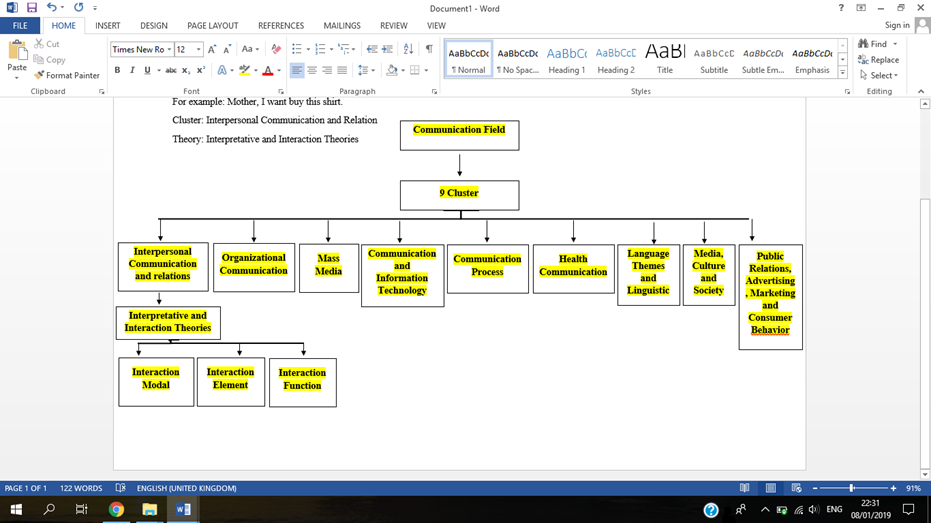
For example: Mother, I want to buy this shirt.

Cluster: Interpersonal Communication and Relation

Theory: Interpretative and Interaction Theories

Modal of Communication

Communication modal can be divided into two criterial modals, which is Linear modals and Circular/Interaction modals.

Linear modal aims to understand communication process. Communication process is about the sender’s use of message to influence or affect other people. While this communication process is also a one-way communication exclusively (Larry L. Baker, 2002:10). For example: presenting assignments to classmates. This communication process will involve communicate, message, channel, receive and the final effect. 

Based on Laswell Modal of Communication, the Linear modal was developed by his earliest model of communication. Laswell’ model communication will begin with the communicator or sender, either the communicator is in a group or is individual. The communicator is the person who begins or initiates the communication process. While the communicator also acts as a source to convey messages to receivers. Therefore, communicator says what message means, the communicator will choose certain messages to convey to the receiver. Channel in Laswell model means that communicator will conduct communication through which channel to deliver the message. Communicators will decide through face-to face or by gadget to deliver the message. Communicators can decide to which once receiver, they want them to receive their message. Since the receivers accept the message, receivers will be interpreting the message, that means the message will affect or influence the receiver. 

Cluster: Interpersonal Communication and relations

Theory: Interpretative and Interaction Theories

a) Communication Content and Relationship (Choose)

b) The nature of the relationship depends on how both parties punctuate the communication sequence

c) Communication is symmetrical or complementary

Example 1: Mother, I want to buy this shirt.

i) Communicator: the teenagers

ii) Message: buy shirt

iii) Channel: face-to-face talk with mother

iv) Receiver: mother

v) Effect receive: will buy or not buy this shirt for her child

Example 2: Source: (Margaret H. DeFleur et.al., 2014:10)


Circular/Interaction modal

Circular or interaction modals of the communication process will include concepts of feedback. Feedback means the receiver’s response to a communicator’s message.

Osgood- Schramm Circular Model of Communication (1954)

Based on Osgood- Schramm circular model of communication, it will begin with the Encoder. Encoder means that a communicator translates ideas, concepts and intentions into verbal and nonverbal messages. Communicators will produce messages based on verbal and nonverbal communication. Usually, verbal communication communicators will use words to convey massages, while nonverbal communication is through communicators’ behaviours such as facial expressions, tone of voice, gestures and body movement to influence receivers. Encoders will choose certain channels to convey messages either face-to-face or though gadgets to receivers. Since receivers start the process of interpretation of the message into thoughts, ideas and concepts, this means the receiver are Decoders. At the same time, when encoder start to share their messages or when the decoder sends their feedbacks, interferes (noise) will occur. This will affect the ability of the decoder and the encoder to accept the message. Feedback will be sent by decoders to answer the message of the encoder and the encoder will then interpret the messages decoders convey.

Cluster: Interpersonal Communication and relations

Theory: Interpretative and Interaction Theories

a) Communication Content and Relationship (Choose)

b) The nature of the relationship depends on how both parties punctuate the communication sequence

c) Communication is symmetrical or complementary

Example 1: Mother, I want to buy this shirt.

i) Encoder: the teenagers with wanted facial expressions (nonverbal communication)

ii) Message: buy shirt

iii) channel: face-to-face talk with mother

iv) Decoder: mother receives her child thought

v) Feedback: mother will say this cloth suitable or not suitable for her child

vi) Effect: influence mother with wanting facial expressions (nonverbal communication) to choose to buy or not buy

Example 2: Source: (Teri Kwal Gamble and Michael Gamble, 2008:13)


Theory of Communication

       Reality in life, we always working with theories of communication. Since we work, gathering with friend, talking with family, bought something in supermarket and so on. Therefore, theories provide us with a lens by which side to view the world. We consider a communication theory can to be any systematic summary about the nature of the communication process. Based on Frank Dance, the University of Denver scholar has been published the first comprehensive book on communication theory, catalogued over 120 definition of communication (EM Griffin, 2009:6). Communication is an essential part between people and between people and a group. Communication can also define it as human society.

Although they can communicate in different ways, they communicate with each other through their thought and interpretation. Communication theory was proposed by SF Scudder in the year 1980. It states that human on the planet started communicating with each other, although the way they communicate are different. We also define human communication is a part of biologically and culturally based, complex, continuing, and interactive process in which two or more people use verbal and nonverbal symbols to shape, reinforce, or change one another’s behaviours (Larry L. Baker, 2002:18-19). The way human communicates in society including verbal communication and nonverbal communication. Verbal communication includes oral and written communication. Meanwhile, nonverbal communication includes body language and facial expression.

Example: child fails his’s exam, parents will not only express their dissatisfaction through language to scold his child, but also express their angry in facial actions.

i) Verbal communication: parents express their dissatisfaction through language to scold is child

ii) Nonverbal communication: parents’ angry action apparently on his facial expression

Conclusion

Position modal in communication is to explain how communication work in human behavior and how communication faction in human life. While position theory in communication is to describe what is the meaning of communication based on certain field of scholar.

5 Question Revision

Question 3: By using a diagram, how do you use communication theory in deductive and inductive research approaches?

i) Emily

ii) Masnirah

Deductive and inductive reasoning are both based on facts, or evidence. Generally, inductive reasoning begins with specific facts and concludes with generalizations while deductive reasoning begins with a premise that is valid to reinforce or develop a right and official conclusion. Inductive and deductive reasoning often times get mistaken for one another, but the differences are pretty crucial to understand. One type of reasoning guarantees a right conclusion, and the other type gives you a “well most likely” kind of answer. Part of the reason these two types of reasonings get confused is, because a lot of us will have used the type of reasoning that gives us the “well most likely” conclusion but try and pass it off as a guaranteed right conclusion. There are multiple problems with doing this, but one of the problems with doing this is that it has seemed to muddy the right understanding and use of these two reasonings.

First, deductive reasoning. Deductive reasoning begins with a premise that is valid to reinforce or develop a right and official conclusion. When working out math problems you are using deductive reasoning.

For, example:

x=b

b=1

Therefore, x=1

Here is an example of deductive reasoning that is not Math:

All living things need water to survive.

Frogs are a living organism.

Therefore, frogs need water to survive. Here is another example based on the diagram below.

You can see, in each of these examples, the conclusion is built on an objectively true premise, and minor premise. Deductive reasoning is commonly referred to as top-down logical, and this name helps to give us a really helpful, I think at least, visual of how deductive reasoning works.

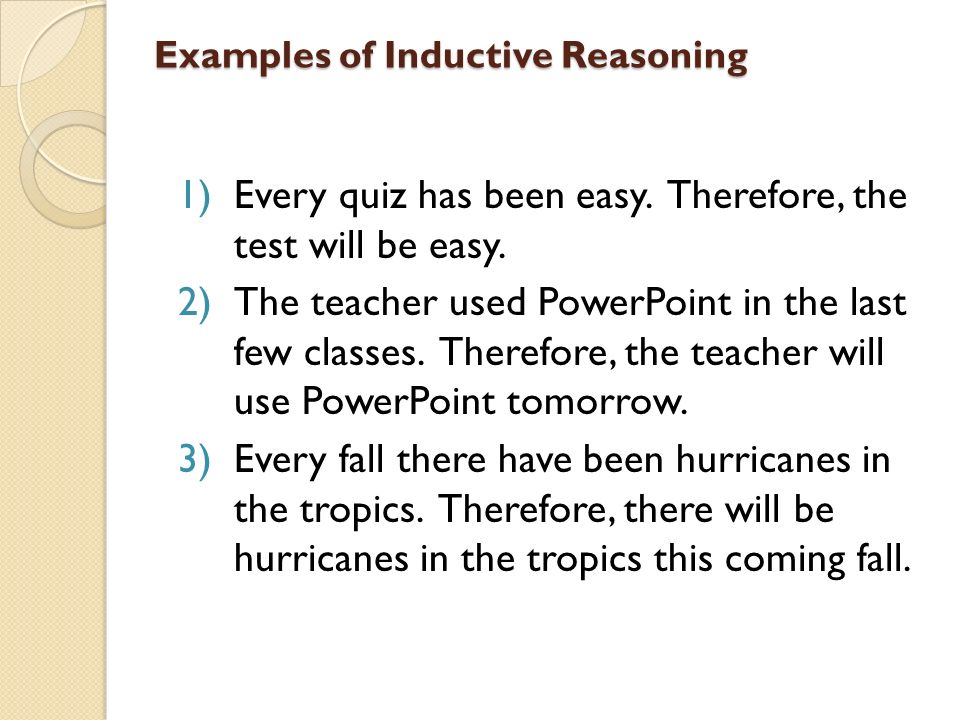
Inductive reasoning is when you have a specific data, and you move to make a general conclusion based on that specific data.

Here are a couple examples of inductive reasoning:

You’re a soccer player and you’re tall, therefore all soccer players must be tall.

All of my brothers are athletic, therefore all boys are athletic.

You can see in each of these examples how, it starts out very specific, and moves to a generality.

Inductive reasoning is commonly referred to as bottom-up reasoning, because it starts out trying to prove a specific conclusion from the get-go. It will start with a conclusion. Then, move to a specific instance. Perhaps, a second specific instance will be provided.

When using inductive reasoning you are, at best, guaranteed a probable conclusion. Finally, a generalization is made from the specific instances. Here is some example based on the diagram below.

5 Question Revision

Question 4: By using an example of communication phenomenon, how do you decide which theory cluster to refer to and choose a theory to explain the phenomenon.

i) Perra

ii) Lynnia

Example of Phenomenon: People argue at comment section on Facebook

Using the example of phenomenon above, we need to find which theory cluster related to it. There are 9 theories clusters we can refer:

  1. Interpersonal communication and relations
  2. Organizational Communication
  3. Mass media
  4. Communication and Information Technology
  5. Communication Process
  6. Health Communication
  7. Language Themes and Linguistic
  8. Media, Culture and Society
  9. Public Relations, Advertising, Marketing and Consumer Behavior

Cluster: In this case, based on the phenomenon chosen, it related to Interpersonal Communication and Relations.

Note: Besides, we can choose other cluster that also may related like mass media or communication and information technology since the phenenomenon are using social medias.

Theory: Based on the cluster chosen, there are numerous theories under it. For this phenomenon we will use Argumentation Theory. This theory explain how people argue. And it’s close related to the phenomenon given.

Note that one PHENOMENON can use other clusters and theories because theories can be use to PREDICT; It’s not based on truth.

SECOND EXAMPLE

PHENOMENON : A student search further informations about History subject through social media.

The theory cluster that related to the phenomenon is MASS MEDIA. For this phenomenon we will use Uses and Gratifications Approach Theory. This theory explain of the media uses and it is very close related to the phenomenon given.

5 Question Revision

Question 5: Explain why different theory clusters can have the same theories under it?

i) Ivy Joycee (BA18110468)

ii) Nurkhalisa

Communication cluster is where all theory that had the possibility to explain a communication phenomena were keep below it. There’s 9 different communication cluster which under it there’s many theory laying but we may found that there’s a same theory in different cluster.
For example : In Mass Media cluster and media, culture and society cluster there had a same theory that can use to explain the phenomena which is “spiral of silence”

Meaning : Spiral of Silence Theory
The minority tends to keep their opinion silent. They were afaird to voice out their opinion publicly because afaird of being isolated.

This happen because both cluster happen to have a similarity which is both cluster aims is formation of public opinion. The spiral of silence theory can be use on both cluster to explain the phenomena.

Example of Phenomena : Taking about politic in media social
Communication Cluster : Mass Media & Media, Culture and Society
Theory Used : Spiral Of Silent
Explanation : Under the cluster of mass media and media,culture and society the phenomena shows that media social has the power where user can talk openly through it. Media social had become a medium where people talk about politic openly and everyone can gladly says their opinion. While the theory explained that among those people theres a person that kept the opinions silent. This happen due to when the dominant side had the public attention this minority tend to just stay silent because their afaird of rejection. They afraid whatever they said that against the dominant opinion their will been bashed and isolated by the public.This has shown that even under different cluster the phenomena is explained exactly the same by the same theory. The function of the theory is still the same even it was put under different communication. Both cluster pointed that when comes to public the spiral of silent theory is exist to explain that not all person in this society will able to express their opinion openly in the public.