Featured

Lecture Name: Sir Suhaimi Bin Salleh

Course           : Teori Komunikasi

Course Code   : AK10203

Bil Name of Group Members No. Matric Tasks
1. Chau Yen Ching   BA18110410 Compile and Edit blog
2. Emily Moin   BA18110456  
3. Ivy Joycee Christopher   BA18110468  
4. Hanis Saulus   BA18110839  
5. Lynnia Chari@ Chali   BA18110387  
6. Masnirah Binti Mohd Azman   BA18161077  
7. Michelle Chong Hui Mui   BA18110481  
8. Nurkhalisa Farhain Binti Dulamid   BA18161013  
9. Perra Anak Lanting   BA18110487   Created blog
10. Qi Yining   BA17271105  
Featured

1.0 What is Communication?

Masnirah Binti Mohd Azman (BA18161077)

Communication is sending and receiving information between two or more people. The person sending the message is referred to as the sender, while the person receiving the information is called the receiver. The information conveyed can include facts, ideas, concepts, opinions, beliefs, attitudes, instructions and even emotions.

Featured

1.1 The Function Of Communication

Qi YiNing (BA17271105)

    In current society, the mass media has important role in many field. As a mass media with a strong voice, it is an effective way for the public to understand the external world and grasp the social dynamics. It is full of all aspects of social life and has exerted an immeasurable impact on the public. In terms of ideology, value guidance, the influence of the mass media also contain great power: by passing information, the mass media to the audience opinion, values, ethics, such as the subtle influence of cognitive system and value system, and the invisible guide and control function, achieve the effect of media publicity.

   First media function is widely used in education field. Firstly, it indirectly USES media to publicize the meaning and purpose of education, which is subtly influenced by knowledge information transmission and entertainment programs. Second, direct use of the media to impart expertise, such as newspapers, radio, television, the Internet and so on. Mass communication function are amplifiers that enable educators to transcend the role of ordinary communicators. “The mass media have the function of inheriting social culture, so that the spiritual heritage of society, such as scientific knowledge, literature and art, and values, can be inherited and developed. In the past, the responsibility of disseminating cultural knowledge was mainly undertaken by families and schools, but with the continuous expansion of media functions, now we can get the knowledge we want from various channels.

    Guiding the direction of public opinion is the most important function of the media, which has positive and negative functions. The positive functions mainly include: first, the mass media can timely send messages to people about various major events, such as natural disasters or war threats, so as to urge them to take early defense. Second, mass media also provide information about public utilities, economic conditions and other information about people’s living environment, which is the daily information needs of society and individuals. Third, we should promptly publicize all kinds of behaviors that violate the law of social development and disrupt social order in order to condemn them morally, consolidate and strengthen social norms, and maintain a virtuous social cycle. Fourth, publicizing good deeds done by some people can enhance social prestige, reputation and social status. Fifth, positive reports maintain and consolidate the rule of the ruling class, and exert the media’s role of invisible scrutiny or public opinion control. The negative functions mainly include: one is that too much information will make the individual feel at a loss for what to do, resulting in numbness. Second, the flow of information will constitute a latent threat to a social system. Some news information reflecting the real situation, such as the loss of war, leaders’ misdeeds and other information, as well as the propaganda of hostile parties, once given the opportunity to spread, will affect the authority of rulers and even endanger their rule. Third, the free circulation of cultural knowledge will result in cultural infiltration or even cultural aggression, which is not conducive to the dissemination of national culture. 

     Social value normative function. The solution of social problems does not only rely on the government to solve them. In a sense, the degree of solving social problems depends on the satisfaction of the public, and mass media is the place of public opinion provided by various values and normative functions of this society. In the fierce collision between the new and the extinct value system, the progress and the backwardness, the change of value structure will be promoted, and the public will easily feel the drift of traditional values and the vagueness of new values, and be in a state of bewilderment. Value standard of mass media is the correct guidance, to pass specific social value standard and code of conduct, and constantly adjust to adapt to the development of certain social value evaluation standard, to form a new evaluation standards, and standardize people’s social value evaluation, to keep the public’s value system in a reasonable range, not too radical nor too negative. Through media publicity, the public can feel a crisis in their comfort, and strengthen their awareness of this crisis, which will constantly urge human beings to march in difficulties and survive in the crisis, so that the public can form a more unified social values, prevent and detect the emergence and occurrence of crisis at any time, and promote their own people to work hard. But at the same time, most of the values advocated by the media are led by the government. When the government chooses the right values, it is inevitable that mistakes will occur. Such wrong values will lag behind in the society and will not be found out directly. So this function requires the government and the public to improve their ability to distinguish right from wrong.

     Affect the function of public emotion. Social disaster is the most likely to cause public emotional excitement, and the excitement of the burning and extinguishing of the main by the degree of media publicity, therefore, the correct guidance of the media, can stabilize the public mood, cohesion of social forces, jointly overcome the crisis. The function of affecting public emotion is firstly reflected in the emotional comfort function of news media. For example, if there is a social crisis and people’s lives and property are seriously threatened, the mass media should consciously and promptly convey to the public knowledge and information on how to prevent crises and reduce risks, and provide them with the most urgent knowledge and information on how to get relief in a crisis. In addition, during the crisis, the government should control the media, using mass media to spread information quickly, the advantages of wide coverage, in a timely manner to the people sent to the government’s concern, in a timely manner to the people the government and the people were true, the danger of message, highlight moment care about their life and property security, to enhance overcome the crisis of confidence, people call for the masses of the people in the disaster area donation, etc. In this way, people in a crisis will not have panic, take risks to survive, or abandon themselves to harm society. Which we see in the mass media have a kind of phenomenon, why floods, which occurred in somewhere in a major accident, mining, transportation, etc will be in the first time see the figure of the government in active operation, and the media constantly tracking reports, in addition to grab news, is mainly sets up the government image, express the government is backed by the individual survival, can be widely launch social resources, provide humanitarian aid for victims of the crisis, remove the victim helpless and desperate mood, to enhance public confidence. The rapid dissemination of information can enable more and more people to participate in disaster relief, as soon as possible to help the disaster areas through difficulties, restore productivity.

      Cultural and entertainment functions. Regulating body and mind or providing entertainment is also an essential function of mass media in modern society. With the development of culture and the increasing contact with the outside environment, people need entertainment more and more. Recreational activities not only enable people to get rest to maintain vitality, but also invisibly cultivate the public’s cultural interest and aesthetic taste. The positive function of cultural entertainment is the most obvious, which can improve the aesthetic level of the public, cultivate public cultural taste, advocate good social customs, regulate the function of body and mind, promote social harmony and promote social development. Especially in the era of digital media, people’s desire for entertainment has been further satisfied, which has turned many things they had feared or could not get into reality, changed the situation that culture has been owned by a few people for a long time, and greatly promoted social equity. However, the rapid development of culture, especially digital media, has further satisfied the needs of entertainment. At the same time, the negative function of culture and entertainment is also emerging, and increasingly intensified. The culture and various entertainment programs transmitted by mass communication are characterized by speed, quantity, popularity and simplicity. The entertainment provided by the media may increase people’s passivity and encourage all kinds of bad emotions, thus diverting the attention of the whole society and greatly weakening the positive function of the mass media. Not only that, a large amount of pornographic and violent information will have a bad impact on teenagers, and lead to crimes and other problems keep emerging, which requires us to improve our ability to identify information and strengthen our ability to resist temptation.

    As the public opinion place where the pluralistic values of the society blend, mass media plays a crucial role in guiding the values of the society, and it is its inescapable social responsibility to regulate and guide the values of the society. Therefore, mass media should shoulder the social responsibility to firmly abide by the boundaries between morality and law when disseminating cultural information and guiding values. Meanwhile, they should disseminate correct and advanced values in line with social development and play a guiding role in social values

Featured

2.0 What is Theory?

HANIS SAULUS (BA18110839)

       A set of assumptions, propositions, or accepted facts that attempts to provide a plausible or rational explanation of cause and effect (causal) relationship among a group of observed phenomenon. The word’s origin (from the greek thoros, a spectator), stresses the fact that all theories are mental models of the pereived reality.

Think of theories as a pair of glasses. Corrective lenses allow wearers to observe more clearly, but they also impactvision in unforeseen ways. For example, they can limit the span of what you see, especially when you try to look peripherally outside the range of the frames.

      communication theory, the discipline that studies the principles of transmiting information and the methods by which it is delivered (as print or radio or television );” communication is this major field of study”. communication thoery a numerical measure of the uncertainty of an outcome; ” the signal contained thousands of bits of information”. 

Theories operate in a similar fashion. A theory can illuminate an aspect of your communication so that you understand the process much more clearly; theory also can hide things from your understanding or distort the relative importance of things. We consider a communication theory to be any systematic summary about the nature of the communication process. Certainly, theories can do more than summarize. Other functions of theories are to focus attention on particular concepts, clarify our observations, predict communication behavior, and generate personal and social change (Littlejohn, 1999). We do not believe, however, that all of these functions are necessary for a systematic summary of communication processes to be considered a theory.

Most of us make these types of summary statements on a regular basis. The difference between this sort of theorizing and the theories provided in this book centers on the term systematic in the definition.

First, the summary statements described in the table are what
are known as commonsense theories, or theories-in-use. This type of
theory often is created by an individual’s own personal experiences, or
such theories might reflect helpful hints that are passed on from family
members, friends, or colleagues. They are useful to us and are often the
basis for our decisions about how to communicate.For example, think about common knowledge regarding deception.

A second type of theory is known as working theory. These are generalizations made in particular professions about the best techniques for doing something. Journalists work using the “inverted pyramid” of
story construction (most important information to least important information). for example, describes a scene in Hitchcock’s Notorious in which the heroine realizes she is being poisoned by her coffee, and the audience “sees” this realization through a close-up of the coffee cup. Working theories are more systematic than commonsense theories because they represent agreed-on ways of doing things for a particular profession.

The type of theory we will be focusing on in this book is known as scholarly theory. Students often assume (incorrectly!) that because a theory is labeled as scholarly that it is not useful for people in business and the professions. Instead, the term scholarly indicates that the theory has undergone systematic research. Accordingly, scholarly theories provide more thorough, accurate, and abstract explanations for communication than do commonsense or working theories.
If you are genuinely committed to improving your understanding of the communication process, however, scholarly theory will provide a strong
foundation for doing so.

3.0 The Theory-Research Link

Chau Yen Ching (BA18110410)

Source: (Dainton, 2004:7)

The Theory research link involves Deductive Theory Development and Inductive Theory Development.

Deductive theory development is generally associated with the scientific method (Reynolds, 1971) such as positivism. The deductive approach requires that a hypothesis, or a working theory, be developed before any research is conducted , which is from general to a more specific approach. Informally, deductive approach can be categorized as a “top down” approach. However, deductive theory focus on gathering rich data from which ideas are induced. Deductive approach requires that a hypothesis or a working theory, be developed before any research is conducted. Once a theory has been developed, the researchers then collects data needed to refine the theory until evidence is enough to support the theory. The constant of deductive approach will set the adjustment of the theories with additional research conducted until the evidence supports the theory.  Deductive theory development starts with the theory and then looks at variables of data on the research.

Deductive approach will begin with thinking up a certain theory. Next is hypothesis, which is the specific method to test the theory. Then, we collected data from observations to support the research theory. Through further report of the research theory, the professional researcher will do the confirmation for the theory research.

Example:

  1. Theory: Interpretative and Interaction Theories (based on Cluster: Interpersonal Communication and Relation)

i)  Act Theory

ii) Aegumenation Theory

iii) Contagion Theories

iv) Classical Rhetoric

 v) Cognitive Dissonance Theory

vi) Elaboration Likelihood Model

vii) Interpretative and Interaction Theory (Choose)

viii) Language Expectancy Theory

ix) Network Theory and Analysis

x) Sensemaking

xi) Social Identity Theory

xii) Symbolic Interactionnism

xiii) Social Cognitive Theory

xiv) Speech Act

xv) Theory of Planned Behavior/ Reasoned Action

xvi) Uncertainty Reduction Theory

2. Hypothesis :find suitable data to support the Interpretative and Interaction Theories

i) Cannot not Communicate: it means even if we are not actually talking, perhaps and do anything, we still communicating.

ii) Human begings communicate both digitally and analogically: analogically communication = represents things by likeness, while digital communication = refers to through which apps is using by communicator to transmitter his or her message to receiver.

iii) Communication Content and Relationship: Content = what we want to communicate? Relationship = How we communicate (Content and Relation are sequences communication.

iv) The nature of the relationship depends on how both parties punctuate the communication sequence: describes how each person perceives, or punctuates a communication sequence.

v) Communication is symmetrical or complementary:  how to made healthy communication = symmetrical communication, while begin with conflict communication = complementary communication ( how i see myself, how I see you = how I see you seeing me)

3. Observation: Through research method of Qualitative observation in community

i) Cannot not Communicate: Nonverbal Communication

ii) Human begings communicate both digitally and analogically: Norverbal Commmuncation

iii) Communication Content and Relationship: Sequence Communication

iv) The nature of the relationship depends on how both parties punctuate the communication sequence: Nonverbal and Verbal communication

v) Communication is symmetrical or complementary:  Healthy Communication and Conflict Communication

4. Confirmation : based on hypothesis and observation

i) Professional will do the confirmation to the Cannot not Communicate,Human begings communicate both digitally and analogically,Communication Content and Relationship,The nature of the relationship depends on how both parties punctuate the communication sequence and Communication is symmetrical or complementary is under theory of Interpretative and Interaction Theories is true.

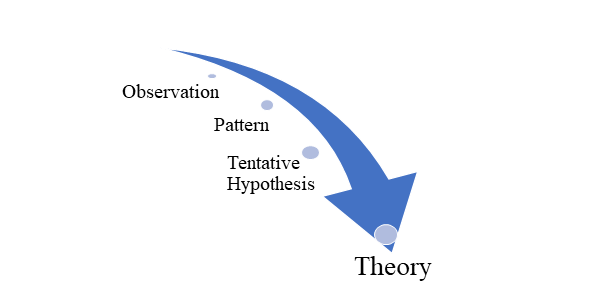
Inductive theory development also has the same meaning with grounded theory, which is that the researcher studies certain topics and based on the result of their research, they develop a new theory or explain it as the research comes before the theory. At the same time, inductive theory is bottom up, which is from specific to general approach .  All field of scholars believe that Inductive theory development is the best approach emerged from the result of systematic study. Inductive approach will let the researcher develop theory of management style which affects employment performance and employee performance in great depth before proposing a new theory. Meanwhile preliminary theories may be proposed, while data will continue to be collected and analysed until adding new data brings little to the researcher’s understanding about the phenomenon or situation.

Inductive approach beginning with specific observation as measure, then continue it to detect patent with regularities data. Inductive approach also formulates the tentative hypothesis, which can make researchers explore during their research. In the end, researchers will end up developing general conclusion as the theory of inductive approach research.

Example:

a) Observation: The nature of the relationship between both parties punctuate the communication sequence

i) Collected data through observation to build new theory  

b) Pattern: Through research method of Qualitative – Observation in community

i) researcher found that both parties punctuate their felt or how they seeing certain person is through nonverbal communication.

ii) Researcher found that parties will found suitable situation to express their felt or how they seeing certain person is through verbal communication.

c) Tentative Hypothesis:

i) The nature of the relationship between both parties punctuate the communication sequence is true under theory Interpretative and Interaction

ii) Professional will do the confirmation to the theory of Interpretative and Interaction Theories is true.

d) Theory: new theory come out = Interpretative and Interaction Theories

4.0 What is Research?

Emily Moin (BA18110456)

Research is a systematic investigation and study of materials and sources in order to establish facts and reach new conclusions. Research comprises creative and systematic work to increase the stock of knowledge, including knowledge of humans, culture and society, and the use of this stock of knowledge. It is used to establish or confirm facts, solving new or existing problems, support theorems or develop new theories. A research project may also be an expansion on past work in the field. Research projects can be used to develop further knowledge on a topic or in the example of a school research project. They can be used to further a student’s research prowess to prepare them for future jobs or reports. In order to test the validity of instruments, procedures or experiments, research may replicate elements of prior projects or the project as a whole. The primary purposes of basic research are documentation, discovery, interpretation or the research and development (R&D) of methods and systems for the advancement of human knowledge. There are several forms of research such as scientific, humanities, artistic, economic, social, business, marketing, practitioner research, life, technological and many others.

5.0 Experiment-Research Methods In Communication

Lynnia Chari @ Chali (BA18110387)

Experiments method in communication is not necessary to use equipments such as Bunsen burner or beaker inside as long as there are ultimately concerned with causation and control. Experiment is the only research method that allow researchers to conclude that one thing causes another. 

In experiment research, the researcher is concerned with two variables. One of the variables is the presumed cause. This is known as the independent variable. The other is the presumed effect that also known as dependent variable. For example, if you want to determine whether friendly customer service causes greater customer sastifaction, whether advertisers’ use of bright colors produce higher sales or whether sexuality in film leads to more promiscuous society, the only way to determine these things is through experimental research. Therefore, if you are interested in knowing whether bright colors in advertisements cause increased sales, your independent variable is the color and the dependent variable is the amount of sales dollars. 

Experiments research take two settings. Laboratory experiments take place in a controlled setting. In communication field, laboratories are often rooms that simulate living rooms or conference room. Some experiments don’t take place in the laboratory and these are called field experiments because they take place in participant’s natural surroundings. These sort of experiments always take place in public places, such as shopping malls, libraries, or schools, but they might take place in private areas as well. 

5.1 Survey Research -Research Methods in Communication

Nurkhalisa Farhain Binti Dulmaid (BA18161013)

Survey Research is one of the methods communication. The most common means of studying communication is through the use of surveys. Survey research is that it is the only way to find out how someone thinks, feel, or intends to behave. Generally, there are two types of survey research. . Interviews ask participants to respond orally. Example they might take place to meet each other or talking over the phone. Questionnaires ask participants to respond in writing. They can be distributed by mail or administered with the researcher present. Particular types of research are more suited for interviews rather than questionnaires. For example, interviews allow the researcher to ask more tough or complex questions because he/she can clarify misunderstandings through probing questions. However, questionnaires might be more appropriate for the collection of sensitive information because they provide more anonymity to the respondent (Salant & Dillman,1994).

Besides, the key concepts associated with either type of survey research are questioning and sampling. First, the purpose of a survey is quite simple; surveys provide a means to ask questions of a group of people to understand their thoughts, feelings, and behaviors. Questionnaires might take two forms. Open-ended questions allow respondents to answer in their own words, taking as long (or short) as they would like. Closed-ended questions require respondents to respond using set types of answers.

The second key concept associated with survey research is sampling. Researchers are typically concerned with large groups of people when they conduct surveys. These groups are known as a population, which means all people who possess a particular characteristic (Frey et al.,2002). For example, marketing firms want to study all possible consumers of a product.

In addition, Survey researchers study a Sample, or a small number of people in the population of interest. If the sample is well selected and of sufficient size, the results of the survey are likely also to hold true for the entire group. Random samples, in which every member of the target group has an equal chance of being selected, are better than nonrandom samples, such as volunteers, convenience samples (people who meet a particular requirement, such as age, race, etc.). Survey researchers may use any of the random sampling methods identified. Simple random sampling, stratified sampling, stratified sampling, and cluster sampling are among the most frequently chosen. Usually researchers will select the methods that is most cost effective and will satisfy the goals of obtaining a representative sample. In some cases, survey research questions specifically call for a nonrandom sampling method. For example, network studies emphasize the uniqueness of each network as a whole system. Basically, random sample of consumers is more likely to give representative as stopping people at the mall on a particular day to answer a few questions.

In conclusion,social methodology largely depends upon survey methods in its research endeavor as it has the advantage of to have a great deal of information from a larger population. It can also be adapted to obtain personal and social facts, beliefs and attitudes.

5.2 Textual Analysis- Research Methods in Communication

Michelle Chong Hui Mui (BA18110481)

Textual analysis is one of the research methods which is often to be used by communication scholars. According to Frey et al. (2002), a text is defined as any written or recorded message. For example, a television show, a transcript of a medical encounter, an employee bulletin and so on. So, what is actually meant by textual analysis? Textual analysis is the method in which communication researchers use to describe and interpret the characteristics of a recorded or visual message (Frey, L., Botan, C., & Kreps, G., 1999).

One of the objectives of textual analysis is to uncover or describe the content, structure, and nature of the messages contained in one text. Other than that, textual analysis is also used to evaluate messages by focusing on their strengths, weaknesses, and effectiveness. Thus, by using the examples of text stated above, textual analysis can be used to study the amount of violence on television, the way of power dynamics play out during doctor-patient intake evaluations, or even the strategies used to communicate a corporate mission statement. The significant considerations in textual analysis are to select the types of studied texts, acquire appropriate texts, and determine on which particular approach to employ in analyzing the texts.

There are four major approaches to textual analysis including rhetorical criticism, content analysis, interaction analysis, and performance studies.

For scholars, the word rhetoric is associated with Aristotle’s definition: “the available means of persuasion” and criticism is the “systematic process of illuminating and evaluating products of human activity” (Andrews, 1983, p. 4). According to Frey et al. (2002), rhetorical criticism refers to “a systematic method for describing, analyzing, interpreting, and evaluating the persuasive force of messages”. There are five important functions of rhetoric criticism by Andrews (1983). Firstly, sheds light on the purposes of a persuasive message. Secondly, aiding in understanding historical, social, and cultural contexts. Thirdly, to be used as a form of social criticism to evaluate society. Fourthly, contributing to theory building by showing how theories apply to persuasive discourse. Lastly, serving a pedagogical function by teaching people how persuasion works and what constitutes effective persuasion. The four steps to conducting rhetorical criticism are choosing a text to study, choosing a specific type of rhetorical criticism, analyzing the text according to the method chosen, then writing a critical essay.

There are numerous specific types of rhetorical criticism, such as historical criticism (how history shape message), oral histories (personal experience via speaking to know history), historical case studies (text related to salient historical to understand roles of communication), biographical studies (how the messages used by individuals to accomplish what they did), social movement studies (persuasive strategies used to affect historical development), Neo-Aristotelian criticism (whether the specific set of criteria given in Aristotle’s Rhetoric were used to create the rhetorical texts intended to influence audience), genre criticism (evaluating particular types of messages, such as political speeches, or corporate image restoration practices), dramatistic criticism (analyzing texts according to philosopher Kenneth Burke’s view that all communication can be seen in terms of five essential elements that comprise a dramatic event including act, purpose, agent, agency, and pentadic analysis), metaphoric criticism (one can never know reality directly), narrative criticism (all persuasive messages function as narratives such as storied, accounts, or tales), fantasy theme analysis (based on the work of Ernest Bormann, examines the common images used to portray narrative elements of situations described in a text), and feminist criticism (how beliefs about gender are produced and reproduced in messages).

Content analysis seeks to identify, classify, and analyze the occurrence of particular types of messages (Frey et al., 2002). There are two types of content analysis which are qualitative and quantitative content analysis. In qualitative content analysis, researchers are more interesting in the meaning related to messages than with the number of times message variables occur. However, quantitative content analysis refers to the systematic, step-by-step procedure used to answer research questions and test hypothesis. This type of textual analysis is considered as an unobtrusive technique. This is because researchers only study texts that already exist rather than asking people to produce new texts. Content analysis usually involves four steps: the selection of a particular text like newspaper articles, the development of content categories (for instance, “favorable organizational coverage,” “neutral organizational coverage,” “negative organizational coverage”), placing the content into categories, and an analysis of the results.

Next, interaction analysis which is typically focusing on interpersonal or group communication interactions that have been recorded, with a specific emphasis on the nature or structure of interaction. In order to describe interaction, researchers focus on some characteristics as below:
(a) linguistic features: Studies range from the analysis of particular words and sentence components (verbs), to nonverbal features (eye contact & touch), to more interpretive aspects of language (powerful vs. powerless speech);
(b) types of topics that people talk about;
(c) the purposes of specific actions and utterances in an interaction. Conducting interaction analysis involves two general tasks namely obtaining a sample of interaction, and analyzing that sample. In gathering a sample of interaction, researchers make choices which can affect both the type and the quality of the data obtained, including the type of interaction data that are needed, the desired location of the interaction, and the appropriate means to gather the data. In analyzing the sample of interaction, the specific analysis depends on whether the goal is to describe interaction or relate it to other variables.

Last but not least, performance studies is also one of the types of textual analysis. Performance studies refer to the process of dialogue form engagement with one’s own and others’ aesthetic communication through the means of performance. There are six steps in generating and reporting vision in performance studies including selecting communication act or text to be examined, playing different vocal and bodily behaviors, establishing the range of legitimate understandings, choosing valid interpretations to isolate one possible understanding to pursue, repeating to set and refine the chosen interpretations, and presenting of what has been discovered through public performance.

In conclusion, it will be an obstacle for researches to do research by using textual analysis because the actual effects on audience cannot be determined solely by focusing on text.

5.3 Ethnography- Research Methods in Communication

Chau Yen Ching (BA18110410)

Scholars of communication will do the first research method in communication which is Experiments research, while Survey Research is the second research, the third research is Textual Analysis and Ethnography research is the final research method used by scholars of communication to Research Methods in Communication. The concepts of Ethnography research is that the researcher will involve themselves in a particular culture or context to understand the curtain community communication rules and meanings. For example, an ethnographer might study an organizational culture, such as Johnson & Johnson’s corporate culture, or communication in the hospital emergency rooms. Ethnography research is a naturalistic and emergent research, which means that the ethnographer’s research must take place in the natural environment through certain methods to avoid the bias of the environment research occurs.

Therefore, ethnographer research has two kinds of research role. First is Complete Participants and the second one is Participant Observer. Ethnographer researchers should know their role as a Complete Participants which they can’t let the participants know that they are studying them. This approach requires the ethnographer researcher to know more about the environment. Meanwhile Participant Observers means that the ethnographer researcher’s role is to let the participants know that they are studying them and admit ethnographer researchers to enter the environment. Through Participant Observers the ethnographer researcher may choose to be complete observers, which can let them record data and simultaneously limiting insight into participants’ own meaning of the observed communication.

Usually, through these four methods of research, it will let the researchers in communication to collect useful data to support the research of communication